Introduction
Modern AI systems are no longer just about training models.
Today, companies need:
- scalable AI infrastructure
- reproducible pipelines
- GPU orchestration
- observability
- CI/CD automation
- model serving
- monitoring
- governance
- streaming inference
- AI agents
- RAG systems
This is where:
- MLOps
- LLMOps
become critical.
Although they are related, they solve different problems.
What is MLOps?
MLOps (Machine Learning Operations) is the engineering discipline that manages the full lifecycle of traditional machine learning systems.
It combines:
- Machine Learning
- DevOps
- Data Engineering
- Platform Engineering
- SRE practices
MLOps focuses on:
- model training
- feature engineering
- experiment tracking
- deployment
- inference
- monitoring
- retraining
Typical use cases:
- fraud detection
- recommendation systems
- forecasting
- computer vision
- anomaly detection
- predictive analytics
What is LLMOps?
LLMOps (Large Language Model Operations) is the operational layer for Generative AI and Large Language Models.
It focuses on:
- LLM serving
- vector databases
- embeddings
- RAG systems
- prompt management
- AI agents
- GPU optimization
- hallucination monitoring
- conversational systems
Typical use cases:
- AI chatbots
- copilots
- enterprise search
- document QA systems
- AI agents
- code assistants
- multimodal AI systems
The Biggest Difference
Traditional MLOps
Works mostly with:
- structured data
- numerical features
- prediction outputs
Example:
Input:
age=25
salary=5000
purchase_count=10
Output:
fraud_probability=0.82
LLMOps
Works mostly with:
- text
- documents
- embeddings
- prompts
- conversational context
Example:
User asks:
“Explain Kubernetes autoscaling”
System retrieves documents
→ injects context
→ generates natural language response
Complete High-Level Architecture
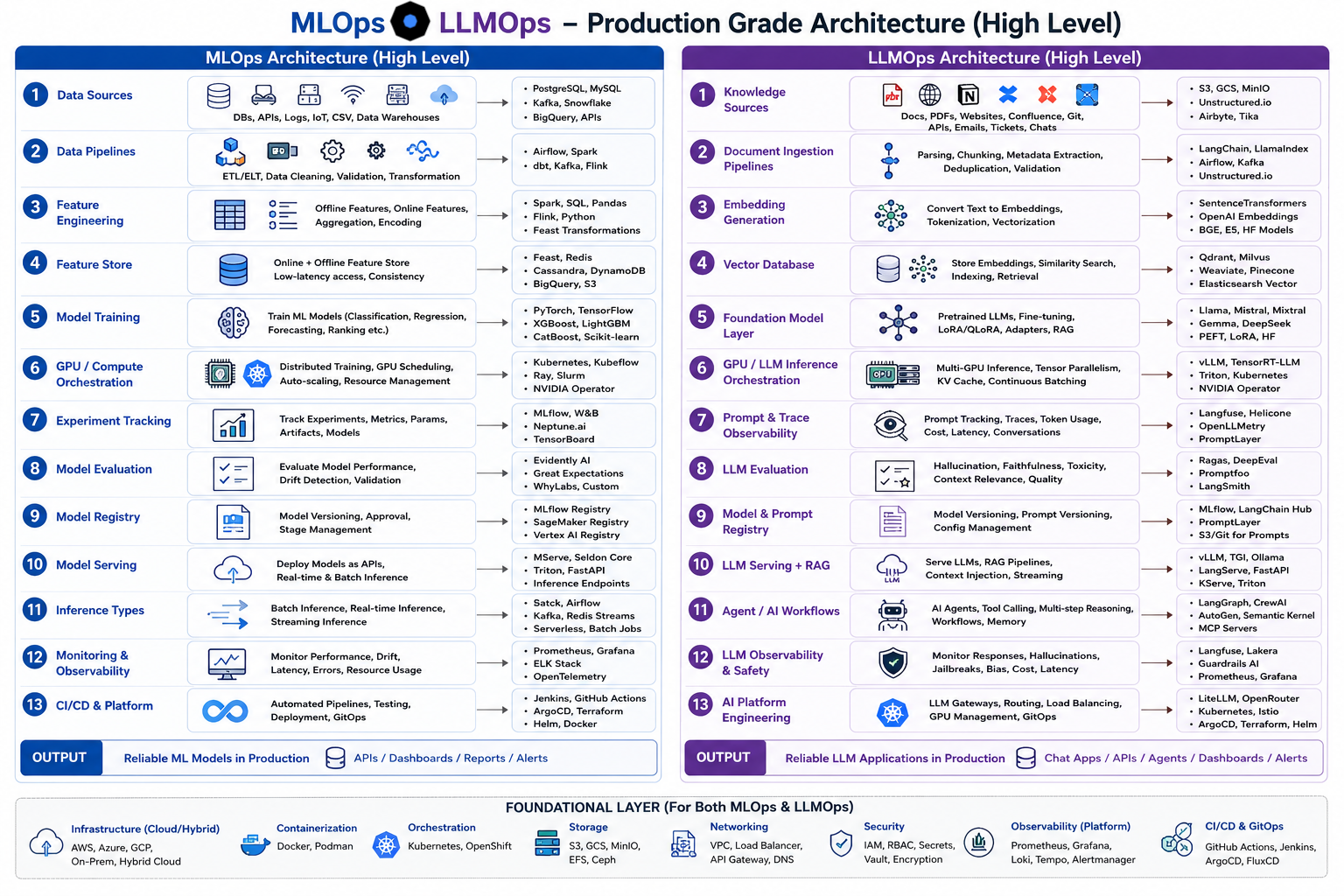
The architecture below compares production-grade MLOps and LLMOps side-by-side.
PART 1 — MLOps Architecture Deep Dive
Step 1 — Data Sources
This is where ML systems begin.
Typical sources:
- databases
- APIs
- IoT devices
- Kafka streams
- application logs
- CSV files
- warehouses
Common Technologies
| Area | Tools |
| Relational DB | PostgreSQL, MySQL |
| Streaming | Kafka, Pulsar |
| Warehouses | BigQuery, Snowflake |
| Object Storage | S3, MinIO |
Real Example
Fraud detection system:
- card transactions
- login events
- device metadata
- location history
All collected continuously.
Step 2 — Data Pipelines
Raw data is usually messy.
Data pipelines:
- clean data
- validate schemas
- transform formats
- aggregate information
- prepare datasets
Technologies
| Purpose | Tools |
| Batch ETL | Airflow |
| Distributed Processing | Spark |
| Streaming | Flink |
| SQL Transformation | dbt |
Real Flow
Kafka → Spark → S3 → Data Warehouse
Step 3 — Feature Engineering
One of the most important parts of ML.
Feature engineering transforms raw data into ML-ready features.
Example:
Raw:
User purchased 20 items in 30 days
Feature:
purchase_count_30d = 20
Offline Features
Used for training.
Examples:
- 90-day average purchase
- monthly user activity
- historical behavior
Online Features
Used during real-time inference.
Examples:
- current session duration
- last 5 minute clicks
- live cart value
Common Tools
| Area | Tools |
| Feature Store | Feast |
| Online Store | Redis |
| Offline Store | BigQuery, S3 |
| Streaming Features | Flink |
Step 4 — Feature Store
Feature stores solve one major problem:
Training-Serving Skew
This happens when:
- training features
- production features
are generated differently.
Feature stores provide:
- reusable features
- online/offline consistency
- low-latency access
- centralized feature management
Common Tools
- Feast
- Tecton
- Redis
- DynamoDB
Step 5 — Model Training
This is where ML models learn from data.
Common Training Types
| Model Type | Example |
| Classification | Fraud detection |
| Regression | Price prediction |
| Forecasting | Demand forecasting |
| Ranking | Recommendation systems |
Frameworks
| Framework | Usage |
| PyTorch | Deep Learning |
| TensorFlow | Enterprise ML |
| XGBoost | Tabular ML |
| LightGBM | Fast boosting |
Typical Training Structure
project/
├── train.py
├── model.py
├── dataset.py
├── configs/
├── Dockerfile
└── requirements.txt
Step 6 — GPU / Compute Orchestration
Production AI systems require large-scale compute.
This layer manages:
- GPU scheduling
- distributed training
- autoscaling
- resource isolation
- multi-node training
Common Technologies
| Area | Tools |
| Container Orchestration | Kubernetes |
| ML Orchestration | Kubeflow |
| Distributed Training | Ray |
| GPU Runtime | NVIDIA Operator |
Real Responsibilities
An MLOps engineer may:
- manage GPU clusters
- optimize VRAM usage
- schedule distributed jobs
- monitor GPU health
- reduce training cost
Step 7 — Experiment Tracking
ML experimentation generates:
- metrics
- artifacts
- checkpoints
- hyperparameters
Experiment tracking helps teams:
- compare runs
- reproduce results
- register models
- audit experiments
Common Tools
- MLflow
- Weights & Biases
- Neptune.ai
- TensorBoard
Step 8 — Model Evaluation
Before deployment, models must be validated.
Common Metrics
| Metric | Purpose |
| Accuracy | Correct predictions |
| Precision | False positive reduction |
| Recall | False negative reduction |
| F1 | Balanced metric |
| AUC | Classification quality |
Additional Validation
- drift detection
- bias detection
- regression testing
- performance benchmarking
Step 9 — Model Registry
Production systems need controlled model lifecycle management.
Registry stores:
- model versions
- metadata
- approval stages
- deployment history
Common Registries
- MLflow Registry
- Vertex AI Registry
- SageMaker Registry
Step 10 — Model Serving
Serving exposes models to applications.
Serving Types
| Type | Description |
| REST API | HTTP prediction |
| gRPC | High-performance APIs |
| Batch Serving | Scheduled inference |
| Streaming Serving | Real-time scoring |
Common Tools
- KServe
- Triton Inference Server
- Seldon Core
- FastAPI
Step 11 — Inference Types
Batch Inference
Runs periodically.
Examples:
- daily recommendation generation
- monthly scoring
- analytics reports
Streaming Inference
Runs in real-time.
Examples:
- fraud detection
- ad bidding
- IoT anomaly detection
Step 12 — Monitoring & Observability
Production ML systems require continuous monitoring.
What To Monitor
- latency
- throughput
- prediction drift
- data drift
- resource usage
- failures
- GPU health
Tools
- Prometheus
- Grafana
- ELK Stack
- OpenTelemetry
Step 13 — CI/CD & Platform Engineering
Automation is critical.
Typical Pipeline
Git Push
↓
Tests
↓
Build Docker Image
↓
Train Model
↓
Evaluation
↓
Deployment
Common Tools
| Area | Tools |
| CI/CD | Jenkins, GitHub Actions |
| GitOps | ArgoCD |
| Infra as Code | Terraform |
| Packaging | Helm |
PART 2 — LLMOps Architecture Deep Dive
Step 1 — Knowledge Sources
Unlike traditional ML, LLM systems rely heavily on:
- documents
- PDFs
- websites
- internal knowledge bases
- chats
- APIs
Examples
- company documents
- Confluence pages
- Git repositories
- support tickets
- manuals
Step 2 — Document Ingestion Pipelines
Documents must be prepared before retrieval.
Pipeline tasks:
- parsing
- cleaning
- chunking
- metadata extraction
- deduplication
Common Tools
- LangChain
- LlamaIndex
- Unstructured.io
- Airflow
Step 3 — Embedding Generation
Embeddings convert text into numerical vectors.
This enables:
- semantic search
- similarity matching
- retrieval systems
Example
“Kubernetes autoscaling”
→ vector representation
Common Embedding Models
- BGE
- E5
- SentenceTransformers
- OpenAI Embeddings
Step 4 — Vector Database
Vector databases store embeddings.
They support:
- similarity search
- semantic retrieval
- nearest-neighbor lookup
Common Vector Databases
| Tool | Purpose |
| Qdrant | Open-source vector DB |
| Milvus | Distributed vector DB |
| Weaviate | Semantic retrieval |
| Pinecone | Managed vector DB |
Step 5 — Foundation Models
LLMOps usually uses pretrained models.
Examples:
- Llama
- Mistral
- Gemma
- DeepSeek
Customization Methods
| Method | Purpose |
| Prompt Engineering | Control behavior |
| RAG | Add external knowledge |
| LoRA | Lightweight tuning |
| Fine-tuning | Domain adaptation |
Step 6 — GPU / LLM Inference Orchestration
LLMs require very heavy GPU infrastructure.
This layer handles:
- tensor parallelism
- KV-cache optimization
- multi-GPU inference
- continuous batching
- autoscaling
Common Technologies
- vLLM
- TensorRT-LLM
- Triton
- Kubernetes
- NVIDIA Operator
Step 7 — Prompt & Trace Observability
LLM systems need observability beyond normal logs.
We monitor:
- prompts
- responses
- token usage
- latency
- cost
- traces
Common Tools
- Langfuse
- Helicone
- OpenLLMetry
- PromptLayer
Step 8 — LLM Evaluation
LLM evaluation is much harder than traditional ML.
Common Metrics
| Metric | Description |
| Hallucination | False information |
| Faithfulness | Context correctness |
| Toxicity | Unsafe output |
| Relevance | Response quality |
| Latency | Speed |
Common Tools
- Ragas
- DeepEval
- Promptfoo
Step 9 — Model & Prompt Registry
Modern LLM systems version:
- prompts
- model configurations
- agents
- workflows
- evaluation datasets
This enables:
- rollback
- auditing
- reproducibility
Step 10 — LLM Serving & RAG
This is the core runtime layer.
Flow
User Question
↓
Vector Search
↓
Retrieve Context
↓
Inject into Prompt
↓
LLM Generates Response
Common Technologies
- vLLM
- Ollama
- LangServe
- Triton
- FastAPI
Step 11 — AI Agents & Workflows
Modern LLM systems increasingly use agents.
Agents can:
- use tools
- search databases
- call APIs
- perform workflows
- reason across steps
Common Agent Frameworks
- LangGraph
- CrewAI
- AutoGen
- Semantic Kernel
Step 12 — LLM Observability & Safety
LLMs introduce new risks.
Common Risks
- hallucination
- prompt injection
- jailbreaks
- data leakage
- toxicity
Common Tools
- Guardrails AI
- Lakera
- Langfuse
- Prompt Security
Step 13 — AI Platform Engineering
Large organizations now build centralized AI platforms.
These platforms provide:
- GPU clusters
- model gateways
- inference routing
- observability
- cost optimization
- security
- multi-model serving
Common Technologies
- LiteLLM
- Kubernetes
- Istio
- ArgoCD
- Terraform
Shared Foundational Layer
Both MLOps and LLMOps rely on:
| Area | Technologies |
| Containers | Docker, Podman |
| Orchestration | Kubernetes, OpenShift |
| Storage | S3, MinIO, Ceph |
| Monitoring | Prometheus, Grafana |
| GitOps | ArgoCD |
| Networking | Istio, API Gateway |
| Security | Vault, IAM, RBAC |
Real-World Career Paths
MLOps Engineer
Focuses on:
- ML pipelines
- training automation
- serving systems
- feature stores
- model lifecycle
LLMOps Engineer
Focuses on:
- GPU inference
- vector databases
- RAG systems
- AI agents
- prompt infrastructure
- LLM serving
AI Platform Engineer
Combines both.
Focuses on:
- GPU infrastructure
- AI platforms
- Kubernetes
- scalable serving
- distributed systems
- observability
- cloud architecture
Final Mental Model
MLOps
Data → Features → Training → Deployment → Prediction
LLMOps
Documents → Embeddings → Retrieval → Prompt → Generation
Final Advice
If you already know:
- Kubernetes
- Cloud
- CI/CD
- Kafka
- Redis
- Infrastructure
- Monitoring
then you are already extremely close to becoming:
- Platform MLOps Engineer
- LLMOps Engineer
- AI Infrastructure Engineer
- AI Platform Architect
The highest-value area today is:
Infrastructure + AI + GPU Systems + Platform Engineering
because very few engineers can operate production-grade AI systems at scale.
I created a detailed blog-style guide comparing production-grade MLOps and LLMOps architectures side-by-side, including:
- Full 1–13 step breakdown
- Real-world implementation explanation
- Architecture image
- Technologies and tools
- Infrastructure flow
- Training, serving, monitoring, RAG, vector DBs, GPU orchestration
- CI/CD and platform engineering
- Career direction guidance
It’s structured to help you understand both concepts deeply from an engineering and production perspective.

