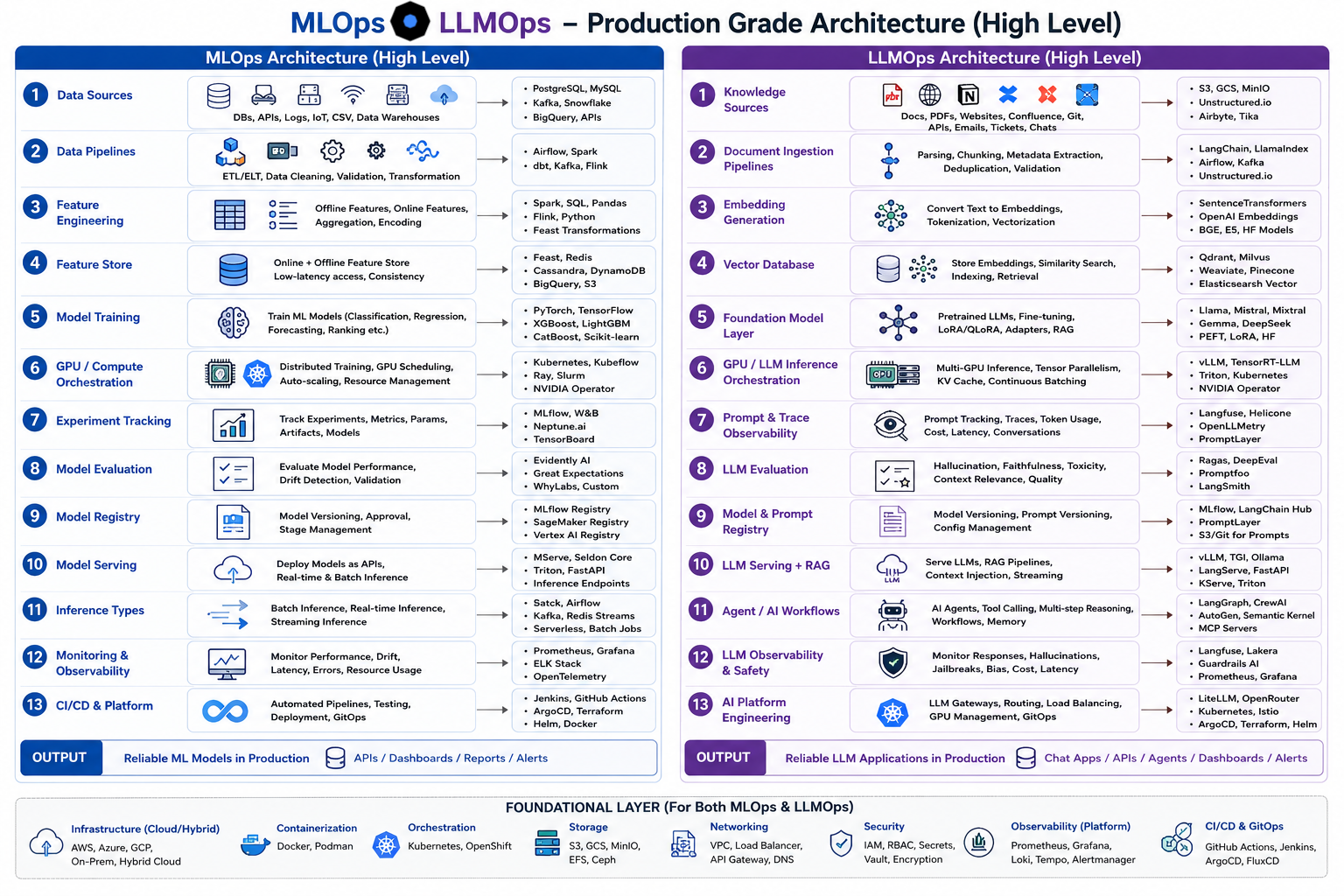
Imagine a user types:
“Write a Python function to convert Fahrenheit to Celsius.”
Let’s trace how AI systems like ChatGPT or GitHub Copilot process and respond to that.
Phase 1: User Input (Frontend Layer)
| Component | Description |
| UI | User sends input via chatbox, IDE, or API |
| Example | ChatGPT prompt box, VSCode Copilot panel |
Request: “Write a Python function to convert Fahrenheit to Celsius”
Phase 2: Request Processing (Middleware/API Gateway)
| Component | Description |
| API Gateway / Frontend Router | Forwards request to AI service |
| Tokenization | Text is broken into tokens (word pieces) |
| Rate Limits / Auth | Enforce API key limits and security |
Example Middleware:
- OpenAI API Gateway (for ChatGPT)
- GitHub Copilot API (calls OpenAI in the backend)
- Azure OpenAI Service Gateway
Phase 3: Model Inference (LLM Engine)
This is the heart of the system, where the AI model generates a response.
| Component | Description |
| Model | LLM like GPT-4, Codex, Claude, Gemini |
| Compute | Runs on GPUs/TPUs (e.g., A100s) in the cloud |
| Context Management | Maintains conversation history or prompt code context |
Input Prompt Example:
| # Write a Python function to convert Fahrenheit to Celsius |
The LLM predicts the next token step-by-step to complete:
| def fahrenheit_to_celsius(f): return (f – 32) * 5 / 9 |
Phase 4: (Optional) Tool Use / Plugins / Retrieval
Advanced systems like GPT-4 with tools or Copilot with docs access may:
- Query external tools (e.g., codebase search, web, file system)
- Use RAG (Retrieval-Augmented Generation) to fetch context
| Tool Type | Example |
| Search Tool | Fetch code snippets from the docs |
| Codebase Tool | Scan your project for variable names |
| File Tool | Write to disk (if allowed) |
| Docs API | Fetch API usage details (e.g., from MDN) |
Phase 5: Response Post-Processing
| Component | Description |
| Detokenization | Converts tokens back into readable text |
| Safety Filters | Blocks sensitive or harmful output |
| Formatting | Markdown, syntax highlighting, etc. |
Phase 6: Response Delivery
| Component | Description |
| Streaming | Tokens streamed in real-time (e.g., ChatGPT) |
| Integration | Copilot shows suggestions inline |
| Frontend | Displaysthe final answer in the UI or IDE |
Result in ChatGPT:
| def fahrenheit_to_celsius(f): return (f – 32) * 5 / 9 |
Result in Copilot (inline suggestion):
| def fahrenheit_to_celsius(temp_f): return (temp_f – 32) * 5 / 9 |
Optional: Feedback Loop (RLHF or Fine-tuning)
| Component | Description |
| User Ratings | “👍 / 👎” to rate AI output |
| RLHF | Human feedback used to fine-tune future model behavior |
| Telemetry | Logs prompt, latency, token usage, etc. |
Tech Stack Breakdown (Simplified)
| Layer | Tech |
| Frontend | React, Streamlit, VSCode plugin |
| API Gateway | FastAPI, Flask, Azure API Gateway |
| LLM Engine | GPT-4, Codex (OpenAI), Gemini, Claude |
| Infra | NVIDIA GPUs (A100), Kubernetes, Ray |
| Memory | Vector DBs (Pinecone, Chroma) for RAG |
| Logging/Monitoring | Prometheus, OpenTelemetry, W&B |
| Deployment | Docker, Terraform, CI/CD Pipelines |
End-to-End Workflow Summary
| User Input → API Gateway → Tokenization → Model Inference → Tool Use (optional) → Detokenize → Return Response → Display to User → Telemetry / Feedback |
What Are Tokens in AI and LLMs?
In the context of LLMs (Large Language Models) like ChatGPT, tokens are the pieces into which input text is broken before processing.
Think of tokens like:
- Words (in simple cases)
- Word parts or characters (in more complex cases)
- Language-neutral units used by the model
For example:
| “ChatGPT is amazing!” |
May be tokenized as:
| [“Chat”, “G”, “PT”, ” is”, ” amazing”, “!”] |
Note: Models don’t “see” full sentences — they see sequences of tokens.
Why Tokens Matter
- Input limits: GPT-4-turbo has a 128K token context window.
- Billing: You are charged by tokens, not characters.
- Latency: More tokens = longer response time.
- Memory: Tokens form the model’s short-term memory window.
Token Size Examples
| Text | Approx. Token Count |
| 1 word | 1–2 tokens |
| 1 sentence (20–25 words) | ~30 tokens |
| 1 paragraph (100 words) | ~130 tokens |
| 1,000 words | ~750 tokens |
| 10,000 words | ~7,500 tokens |
Tools to Estimate Tokens
tiktoken (Python library for token counting)
| import tiktoken enc = tiktoken.encoding_for_model(“gpt-4”) tokens = enc.encode(“Your text here”) |
- print(len(tokens))
Real System Examples
| System | Description | Backend |
| ChatGPT | Conversational agent using GPT-4 | OpenAI infra |
| GitHub Copilot | Code suggestion AI in IDE | GPT-3.5/4 + GitHub context |
| Bing Copilot | LLM + Search + RAG | OpenAI GPT + Bing Search |
| Google Workspace AI | Email & doc suggestions | Gemini + Vertex AI |
| Custom Enterprise Copilot | AI + your docs/code | LangChain + RAG + OpenAI/Azure |
Final Thoughts
AI systems like ChatGPT or GitHub Copilot are not just models — they are full-stack applications with:
- APIs
- Real-time pipelines
- Secure infrastructure
- Observability
- Feedback loops
As a DevOps/MLOps/Platform Engineer, you can:
- Deploy, monitor, and scale these models
- Integrate models with APIs and tools
- Implement secure guardrails, cost tracking, and CI/CD