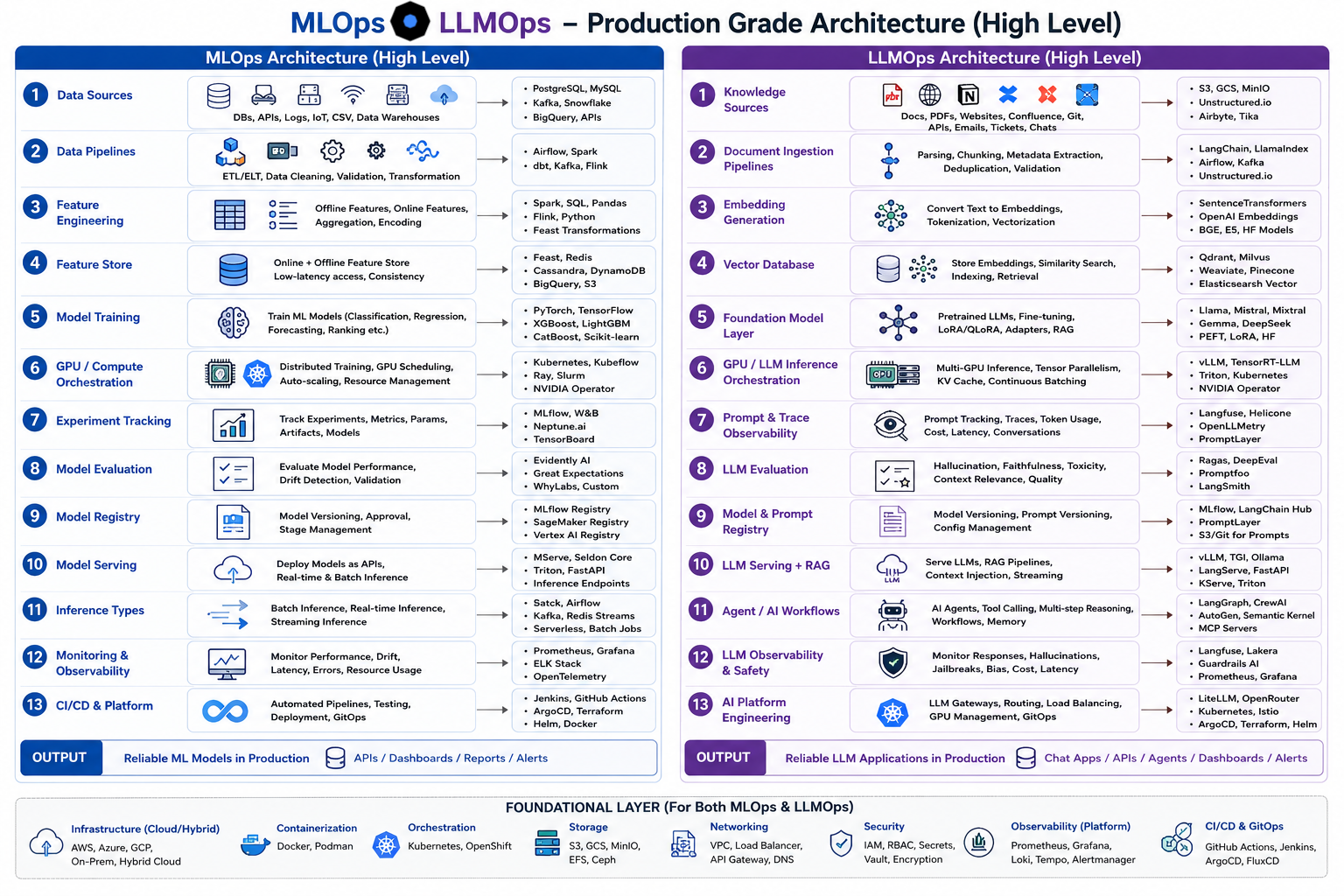
AI is moving from models that just respond to models that act. Enter the era of AI Agents — intelligent systems that can plan, decide, and perform tasks autonomously using tools and memory.
Here, we will learn:
- What AI agents are and how they work
- The architecture behind them
- Tools and technologies used to build them
- Real-world use cases and demos
- How MLOps and DevOps teams can support them in production
What is an AI Agent?
An AI agent is an autonomous software system that:
Observes → Thinks → Acts to accomplish goals — often using LLMs, tools, memory, and external APIs.
Unlike standard LLMs that only generate text, AI agents can actually do things: use tools, browse the web, write files, or call APIs — just like a human assistant.
Examples of AI Agents
| Name | Description |
| Auto-GPT | LLM agent that recursively completes tasks with internet + file system access |
| BabyAGI | Task management agent that creates, prioritizes, and executes tasks to reach a goal |
| LangChain Agent | Agent framework that uses memory, tools, and chains of reasoning |
| Zapier AI Agent | Automates multi-app workflows using GPT and tool execution |
| AgentOps | Tooling layer for monitoring and managing AI agents in production |
Architecture of an AI Agent

Think of the agent like a robot worker powered by LLM intelligence and equipped with tools and memory.
Key Components
1. Language Model (LLM)
The reasoning engine ( GPT-4, Claude, Gemini).
2. Planner
Breaks user input into subtasks (“research topic → write outline → generate blog”).
3. Memory
Stores context across sessions — can be:
- Short-term (for conversation)
- Long-term (vector databases like Pinecone, Weaviate)
4. Tools / APIs
Extend the agent’s capability:
- Web search
- File I/O
- Database queries
- Code execution
- Custom APIs
5. Executor
Actually calls the tools in response to planning.
Real Use Cases
| Domain | Use Case | Tool |
| DevOps | An agent that monitors servers and remediates alerts | LangChain + Prometheus API |
| Marketing | Agent that writes weekly newsletters from internal docs | Auto-GPT + Notion API |
| Support | LLM agent that triages tickets and generates replies | LangGraph + Zendesk API |
| Research | Autonomous research bot that finds, summarizes, and stores papers | BabyAGI + Arxiv API |
Tech Stack to Build AI Agents
| Category | Tools |
| LLMs | OpenAI GPT, Anthropic Claude, LLaMA, Mistral |
| Frameworks | LangChain, LangGraph, CrewAI, Auto-GPT |
| Memory | FAISS, Pinecone, Chroma, Weaviate |
| Tool Execution | LangChain tools, custom Python wrappers, OpenAI functions |
| Planning Logic | ReAct, Tree of Thought, MetaGPT |
| Deployment | Docker, FastAPI, Kubernetes |
| Monitoring | AgentOps, Prometheus, Grafana, Weights & Biases |
How It Works: Step-by-Step (Example)
Use Case: Agent that writes a blog post on a given topic
- 🧾 User prompt: “Write a blog post on AI agents”
- 🧠 LLM response: Agent decides it needs to research first
- 🧰 Tool use: Calls web search tool to gather information
- 🗃️ Stores memory: Saves links and notes to vector DB
- 📝 Generates blog: Drafts content using info
- 💾 File output: Saves draft as Markdown in project repo
- 🔁 Loop: Waits for next task, or schedules post
Challenges & MLOps Role
Challenges:
- Unpredictable behavior
- High compute cost
- Security risks (tool abuse)
- Memory leakage or hallucination
MLOps Responsibilities:
| Task | Tools |
| Monitor cost, latency, tokens | OpenTelemetry, W&B, Prometheus |
| Manage memory stores | Chroma, Pinecone lifecycle |
| Audit tool use | Logs + OpenAI function tracing |
| Deploy & scale | FastAPI, Docker, Kubernetes |
| AgentOps | Agent feedback loops, UI dashboards |
Career Implication
AI Agents = The future of AI applications
Roles like:
- Agent Engineer
- AgentOps/MLOps
- LLMOps Specialist
- AI Workflow Engineer
are emerging fast — especially in companies adopting AI assistants, automation bots, and internal copilots.
How to Get Started
Step-by-step:
- Learn LangChain or LangGraph basics
- Build a toy agent (e.g., write blog from docs)
- Add tools (Google search, DB, filesystem)
- Add vector memory
- Deploy with FastAPI + Docker
- Add logging + feedback tracking
Resources
- LangChain Documentation
- LangGraph (for multi-agent workflows)
- CrewAI – multi-agent team building
- ReAct Paper – reasoning and acting
- BabyAGI – task loop agent
Final Thoughts
AI agents are not just another AI model — they are autonomous, action-driven systems that combine reasoning, tool use, and memory.
They don’t just think — they do.
As a DevOps or MLOps professional, you are in a perfect position to enable, monitor, and scale these next-generation systems.